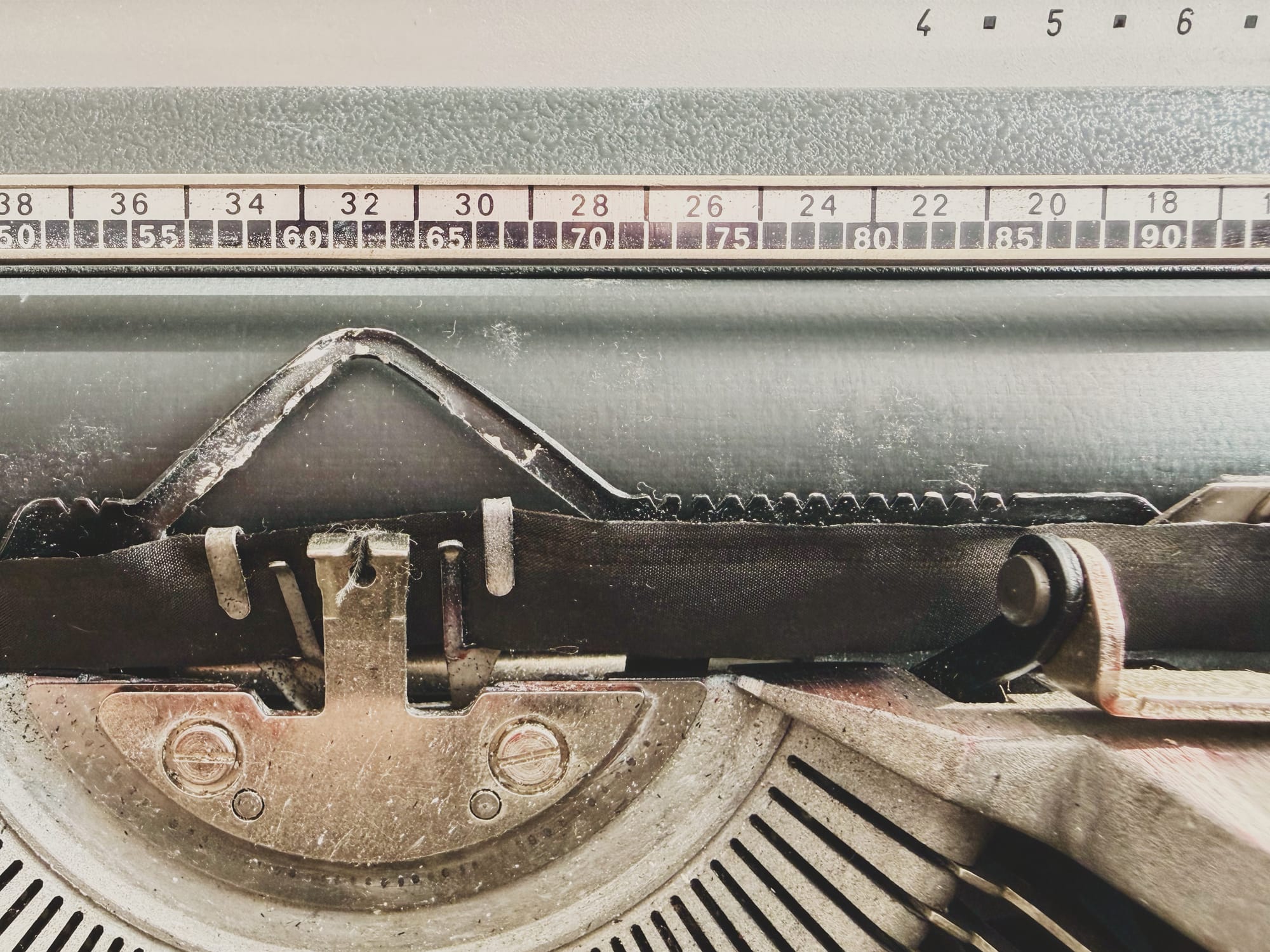
26W16. Never trust a typewriter you can’t throw out a window
I enjoy repairing typewriters, but the Olivetti Lettera 36 tested my patience. It’s what’s commonly referred to as an “electric typewriter”, but should really be called an “electro-mechanical typewriter”. From the outside, it looks like a mechanical typewriter, down to the type bars and ribbon. From the inside, it’s another story entirely.
Mechanical typewriters are wonderful machines that are entirely powered by your fingers. When you strike a key, your energy is transmitted through a carefully designed set of levers and springs, and the type bar strikes the paper. If you strike too hard, you might tear up the paper. If you strike too soft, you’ll get only a faint impression.
At the same time, the heel of the type bar touches the universal bar, which trips the escapement rocker. The loose dog is pushed away from the star-wheel tooth, the carriage moves exactly one space to the left, and through another ingenious set of linkages, the ribbon feed rotates to expose a fresh portion of ribbon. When you reach the end of the line, you push the return lever to return the carriage to its rightmost position, all the while rotating the platen by a set amount of line spacing.
Electro-mechanical typewriters feature the same components, but everything is powered by an electric-motor drive. When you strike a key, the type bar is sent flying away by a constantly rotating drive shaft. Even if you type with an incredibly soft touch, you’ll get a consistent impression, which means you can type much faster than on a mechanical typewriter.
This all depends on a mind-bogglingly intricate assembly of pulleys, belts, and cogs working in perfect harmony. If the motor is weak, if the pulleys are sticky, if the belts are loose, if the cogs are misaligned, if a lever is bent, if you breathe too hard, the timing will be off. The type bars will strike inconsistently (or not at all), the shift key won’t latch (or stop latching), the space bar won’t work (or stop repeating spaces), and the carriage return key won’t return the carriage (or trip in the middle
of a sentence). My Olivetti Lettera 36 exhibited each and every one of these issues. So much for it being advertised as a “fully working model”! First, the motor capacitor was dislodged. Without it, the motor can’t get up to speed. Then, the old grease had congealed into a gooey mess. After (sparsely) reapplying fresh lithium grease where it was needed and cleaning the perished lubrication where it wasn’t, the machine came roaring back to life.
I say “roaring”, but i should say “whining”. The belts were rubbing against the sides of the pulleys because they were far too tight. Following the service manual’s instructions, i loosened them slightly, which made the machine quieter. This was the end of straightforward repairs and the beginning of a tedious game of Whack-A-Mole. I reattached a spring to fix the space bar, but then the carriage return key started acting up. I bent a lever to make it more reliable, but then the shift key stopped working.
Just when i was thinking about going mad, a second Olivetti Lettera 36 showed up. (Don’t ask.) This one had the same grease and belt problems, but after a good cleanup and tuneup, it worked pretty much perfectly. It might not be a coincidence that it’s an earlier model from the early 1970s, as its funky Cooper Black keys attest, at a time when Olivetti was still proud to operate a factory in the heart of Barcelona.
A few years later, the Italian manufacturer had already begun outsourcing production (and even some of its engineering). The other – and still non-functional – model was manufactured in East Germany by VEB Robotron Buchungsmaschinenwerk Karl-Marx-Stadt. You can see the cost-cutting of the early 1980s at play, and it’s not pretty. In a twist of irony, Robotron improved on Olivetti’s design with the sturdier and quieter Erika Electric S2020. That was the end of the road for Olivetti, which stopped manufacturing typewriters entirely, and contracted the design and manufacturing of word processors and computers to Chinese companies.
Things
Olympia Carrera de Luxe MD. Speaking of typewriters, i learned that you could still buy brand-new Olympia Carrera de Luxe and Carrera de Luxe MD electronic typewriters. I wouldn’t be surprised if it was nothing more than a rebadged Nakajima AX/WPT word processor.
Words
Mendacity. It’s been a long time since i’ve learned a new word. “Mendacity” is “the quality of being untruthful”, which, unfortunately, is very much in the air these days.