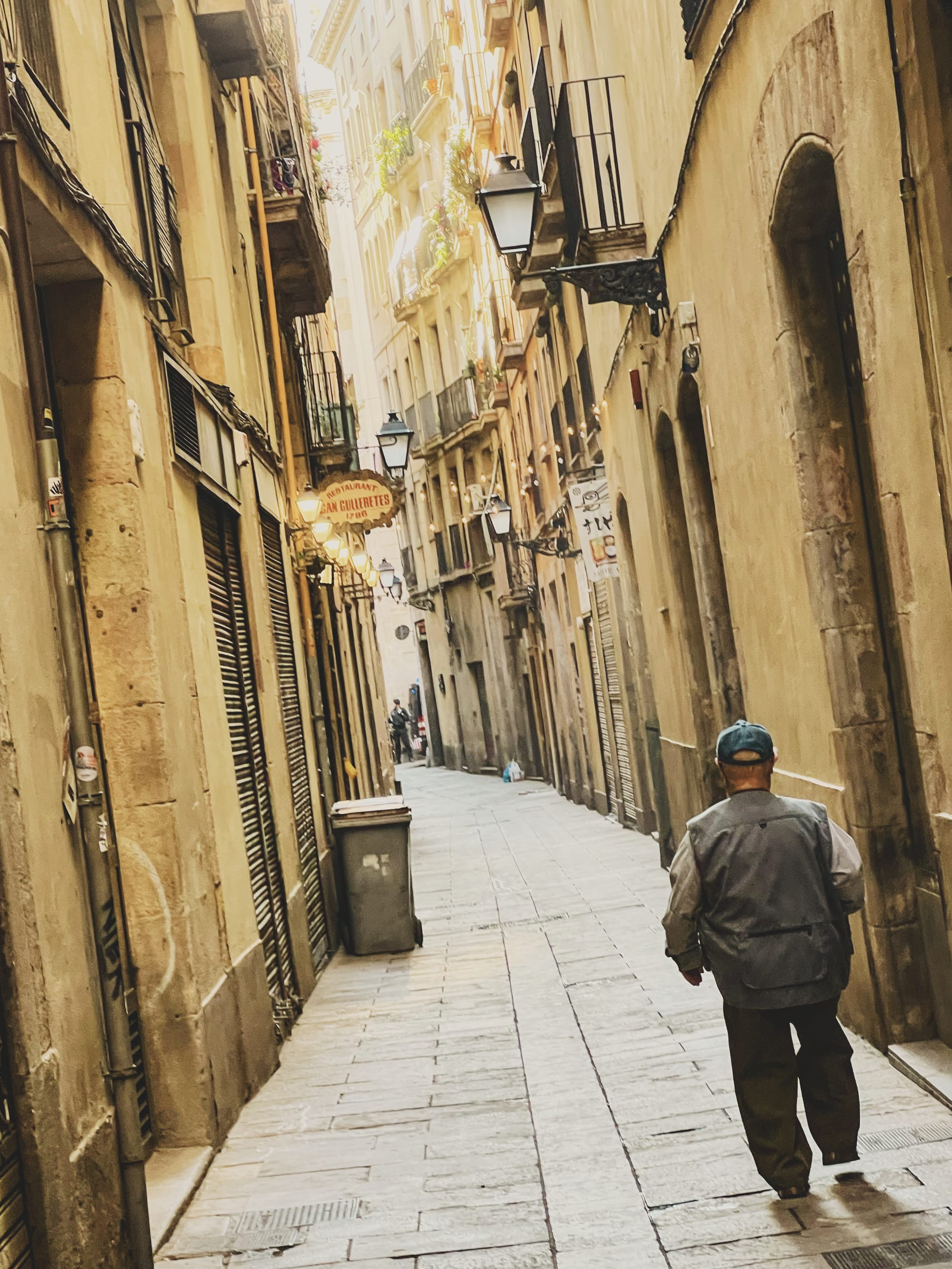
26W15. À la dérive
The sudden change of ambiance in a street within the space of a few metres; the evident division of a city into zones of distinct psychic atmospheres; the path of least resistance which is automatically followed in aimless strolls (and which has no relation to the physical contour of the ground); the appealing or repelling character of certain places — all this seems to be neglected. In any case it is never envisaged as depending on causes that can be uncovered by careful analysis turned to account. People are quite aware that some neighbourhoods are sad and others pleasant. But they generally simply assume elegant streets cause a feeling of satisfaction and that poor streets are depressing, and let it go at that. In fact, the variety of possible combinations of ambiances, analogous to the blending of pure chemicals in an infinite number of mixtures, gives rise to feelings as differentiated and complex as any other form of spectacle can evoke. The slightest demystified investigation reveals that the qualitatively or quantitatively different influences of diverse urban decors cannot be determined solely on the basis of the era or architectural style, much less on the basis of housing conditions.
— Guy Debord, “Introduction to a Critique of Urban Geography”, Les lèvres nues (6).
Flânerie is a kind of reading of the street, in which human faces, shop fronts, shop windows, café terraces, street cars, automobiles and trees become a wealth of equally valid letters of the alphabet that together result in words, sentences and pages of an ever-new book. In order to engage in flânerie, one must not have anything too definite in mind.
— Franz Hessel, Walking in Berlin.
Not to find one’s way in a city may well be uninteresting and banal. It requires ignorance — nothing more. But to lose oneself in a city – as one loses oneself in a forest – that calls for quite a different schooling. Then signboards and street names, passers-by, roofs, kiosks, or bars must speak to the wanderer like a cracking twig under his feet, like the startling call of a bittern in the distance, like the sudden stillness of a clearing with a lily standing erect at its centre.
— Walter Benjamin, “A Berlin Chronicle”, Reflections.
I can’t stand self-aggrandizing “adventurers” who only deal in extremes. Their mere presence is a disruption that’ll precipitate the eventual disfigurement of the places they’re supposedly highlighting. How much carbon did they burn to get there? How many people did they exploit along the way? How much did they destroy with each footstep? They don’t care, because all that matters is that they were there. They need to travel to the wildest, highest, furthest, prettiest, and harshest places to stop feeling so insignificant. Consequences be damned.
I advocate for much more mundane – and sustainable – adventures. You don’t need to study psychogeography to enjoy the dérive, a method of drifting through space without thinking too much about it. A good dérive is all about feel. You should let the place guide you, even if it means retracing your steps down a slightly gloomy street, instead of trying to systematically explore. This isn’t a mere stroll — properly “unplanning” your journey takes a lot of practice and effort.
A dérive is hard enough in a place you’re not familiar with, because you might be tempted to first get a feel for it by looking at a map. It’s even harder in a place you’re familiar with, because you’ve already got a feel for it. You need to rid yourself of such notions as “purpose”, “itinerary”, “destination”, and “return trip”. (You need solid shoes and a water bottle, though.) The territory is the map, and if you’re mindful enough, it’ll lead where you actually needed to go.
I discovered my favourite café by crossing the neighbourhood through a street i’d never taken before. I found a book that changed my life in a derelict second-hand bookshop by going the long way around a tourist spot. I’ve taken a lot of pictures for my typographical project by aimlessly walking around. I also hurt my foot really badly by letting the place guide me far further than was reasonable. Now that’s a proper adventure!
This is my entry for this month’s IndieWeb Carnival, about “Adventure”, hosted by Pablo.
Books
Deaf Sentence by David Lodge. As always with Lodge, fiction doesn’t stray far from life. Before admitting that “the narrator’s deafness and his Dad have their sources in my own experience”, the British writer tried to hide his hearing loss for more than a decade. Deaf Sentence revisits Lodge’s favourite topics — the vagaries of academic life and the sexual (in)discretions of Catholics — without the acerbic tone of his earlier work. All in all, it’s a sweet story of an old professor confronting his own mortality by watching his elderly father wither away. It was Lodge’s penultimate novel before his death in 2025. (I pity the poor translators who had to translate the many plays on words, beginning with the title.)
Links
“The worst of us” by Ian Betteridge. Following Claude Mythos Preview’s announcement, most people focused on its cybersecurity capabilities that allowed it to find “thousands of high-severity vulnerabilities, including some in every major operating system and web browser”, which is incredibly ironic considering Anthropic’s recent data leak. Ian went beyond the press release and read Mythos’ “system card”, which reveals its tendency to deliberately cover up its mistakes. Language isn’t intelligence, but it sure is powerful.
Music
BaRcoDe by Ben Wendel. Ben Wendel, Joel Ross, Simon Moullier, Patricia Brennan, and Juan Diego Villalobos capped their residency at The Jazz Gallery by recording BaRcoDe at The Bunker Studio in Brooklyn. Even if he’s the driving force behind this intriguing blend of modern jazz and postmodern chamber music, Wendel plays his saxophone sparingly, to accentuate the percussion and delineate the mallets (vibraphone, marimba, and balafon). Adopting an architectonic approach to composition is always fraught with danger, but his use of shifting rhythmic signatures and immersive sound design is incredibly successful. What a treat.