26W11. The little book in the velvet-lined case
Some people spend their holidays at the beach. Some people spend their holidays in the mountains. Some people spend their holidays in the countryside. I spend my holidays in museums.
People think of the museum as a rainy-day fallback, but for me, the museum is the plan all along. When i survey the map of a city i’ve never visited, i don’t look for pretty viewpoints and famous restaurants, at least not at first. I search for folk, printing, design, natural history, applied arts and other museums. I’m not against fine arts, but i don’t mind skipping the umpteenth gallery featuring the works of 16- and 17th-century court painters and the vast halls filled with the speculative assets known as “contemporary art”.
What i’m really looking for, over anything else, is evidence of how things were made. I’m seldom struck by the use of chiaroscuro or a clever composition. I’ve been known to be overwhelmed by a single brushstroke. I often fail to see what other people see in the works of the “old masters”. I could spend hours commenting on the recreation of a 14th-century peasant’s dwelling. I like art. I prefer craft.
My love of fountain pens, typewriters and block printing isn’t rooted in nostalgia, but in the fact that they leave their mark on my work. The nib, the slug and the carvings literally imprint every decision, every mistake and every happy accident into the paper. They prove that i was here. At their best, museums do the same thing on a much larger scale. They prove that people were there.
There is also something to be said for the physical experience of entering a museum — the soothing drop in temperature, the surreal lighting, the hush that’s not quite silence. Turns out, conservation and contemplation want the same things. Once you are inside, the museum asks something of you that very little else does any more. Not the fractured, half-given attention of a screen, but something slower and more deliberate.
You stand in front of a thing. The thing doesn’t refresh. The thing doesn’t suggest a related thing that you might like. The thing doesn’t ask you to like and subscribe. The thing doesn’t care for your Instagram subscriber count. The thing simply exists like it’s existed long before you were born, like it’ll exist long after you’ve died. Just for a moment, you share the thing’s plane of existence and your life is a little bit bigger.
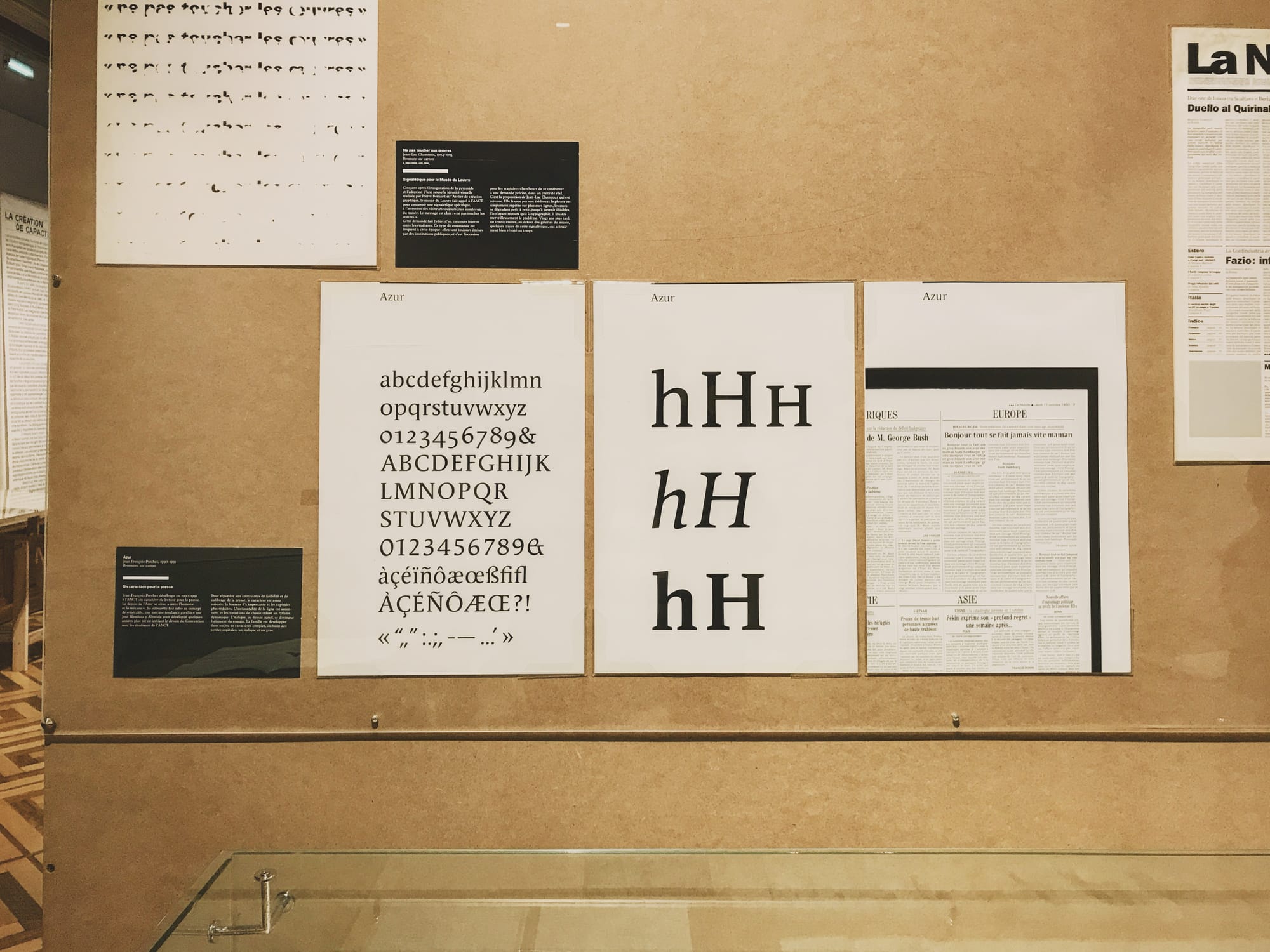
There’s this tiny book in Lyon’s museum of printing and graphic communication. It was printed by Aldus Manutius in Venice around 1514. It’s quite unremarkable at first sight — small, wrinkly, hidden in a corner behind glass. But it uses the italic types that Manutius commissioned from the engraver Francesco Griffo in 1501. This elegantly slanted type, based on a humanist script, was created specifically for this kind of pocket-sized book.
Every slanted character ever (mis)used goes back to this little book in a case on the first floor of a museum twenty minutes from home. Making a point in writing would be quite different if not for it. I visit at least twice a year, like a kind of pilgrimage (sadly, the museum is closed until next year for renovation). I don’t see the book. I see Manutius in his workshop, trying to find a way to squeeze more text on the page. Even writing this, i’m teary-eyed.
This is what museums are for — not the preservation of objects, but the preservation of connections. So i keep coming back. To the printing museum, to the dusty book in the velvet-lined case, to that strange feeling of standing at the starting point of something. And to other museums, seeking other connections, trying to understand what it means to be human. Surely it beats the beach, doesn’t it?
This is my entry for this month’s IndieWeb Carnival, about “Museum memories”, hosted by James.
Apps
Bloom. After what felt like an eternity, my friend Alexandre finally published his note-taking app in the App Store. Bloom is such a simple app that you might wonder what took him so long. Believe me when i tell you that simplicity really is the ultimate sophistication. It took a long time to distil the interface down to the core essence of note-taking and make it feel quick and effortless. There’s still a lot of work to be done on the iPad and the Mac, but knowing Alex, it’ll take only three to fifty more months. Time flies when you’re among friends.
Things
MacBook Neo. A lot of people spent the last week quoting Steve Jobs’s famous quip — “we don’t know how to build a sub-$500 computer that is not a piece of junk” — without ever putting it into perspective. It meant that Jobs didn’t know how to build a laptop with a sub-$200 bill of materials and still make $200 out of it. But Tim Cook does. Apple now builds every part that matters itself, when most PC “makers” are glorified parts assemblers. They waste a lot less money on distribution now that they have their own sales channels and the scale needed to enforce predatory contracts. Most important of all, they dramatically shifted their revenue balance from hardware to services.
That’s what’s making PC makers jittery. They spend a lot on part procurement and product distribution, and they already make all the money they can on crapware. They can’t replicate Apple’s strategy because they own nothing in the value chain and don’t earn a single cent after they’ve sold the hardware. They’re going to hurt big time. Meanwhile, Apple’s going to bring a lot more people into the fold and make even more money with services, enabling them to be even more aggressive with hardware. Their TikTok stories and Instagram reels might be cute and all, but their strategy is as ruthless as ever.